
Free Conflict of Interest Register Template
A conflict of interest register records who declared an interest, what it is, and how the board managed it.
Free. No email required.
What's in the template
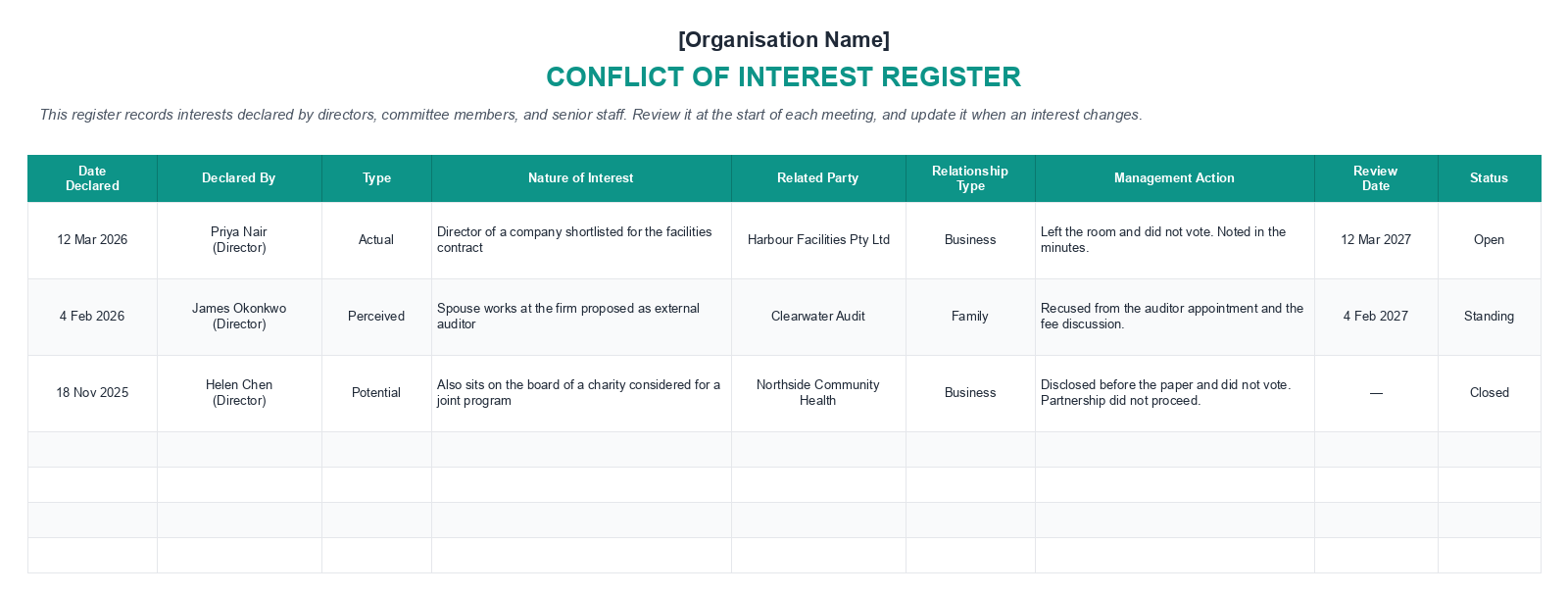
- The same 9 columns in Excel and Word: Date Declared, Declared By, Type, Nature of Interest, Related Party, Relationship Type, Management Action, Review Date, and Status
- Three example rows: an actual conflict, a perceived conflict, and a potential conflict, each with a different status
- Guidance on what to record, suggested values, and how to review the register at the start of each meeting
- Australian governance context, including ACNC Governance Standard 5 and the Corporations Act
What is a conflict of interest register?
A conflict of interest register is the written record of interests that could affect, or be seen to affect, decisions made for the organisation. Each row records who declared, what the interest is, who or what it involves, and what the board decided to do about it.
Your policy says when and how people should declare. The register stores those declarations, and the action the board agreed. Minutes still cover what happened in that meeting. You bring the register to the next one.
An interest does not have to be improper to go on the register. Record actual, potential, and perceived conflicts. Record an indirect interest too, when it comes through a family member or a close associate. If in doubt, declare. There is a longer explanation of the types in how boards handle conflicts of interest.
What goes in each column
Both files use the same nine columns. Type is there so you can mark an interest as actual, potential, or perceived. Delete the three example rows before you use the file. Excel also has a Closed sheet, and dropdowns for Type, Relationship Type, and Status.
- Date Declared
- The date the person declared the interest. That may be the appointment date, the date of a standing declaration, or the date it came up in a meeting.
- Declared By
- The person and their role, such as director, committee member, or CEO. One row per interest. If someone has two interests, use two rows.
- Type
- Actual, potential, or perceived. Actual means the interest is already in conflict with a duty to the organisation. Potential means it could conflict if a particular decision arises. Perceived means a reasonable observer could think it might influence the person, even if it does not.
- Nature of Interest
- What the interest is, in ordinary language. Write "Director of a company shortlisted for the facilities contract", not "Business interest". A person reading the row later should be able to see why it was declared.
- Related Party
- The person or organisation the interest involves. A supplier, an audit firm, another charity, or a family member's employer.
- Relationship Type
- How the person is connected to the related party. Suggested values are Business, Family, Financial, Personal, Membership, and Other. If the interest comes through family or a close associate, record that here.
- Management Action
- What the board decided to do. Disclose only, stay for the discussion but not vote, leave the room, or restrict the papers. If the board allowed the person to participate, record why. The same action belongs in the minutes of the meeting where it was applied.
- Review Date
- When the interest should be confirmed again. Standing interests need a date, usually within a year. An interest tied to one decision can be closed once that decision is finished and minuted.
- Status
- Open: the interest is current and still being managed. Standing: an ongoing notice, checked again on the review date. Closed: the interest has ended, or the matter it related to is finished. Leave closed rows on the register. If you delete them, you lose the record of what the board knew when it made an earlier decision.
After the download
Someone still has to chase each declaration.
Someone still has to email the file out, paste the replies back in, and remember the review dates. Our Cat Herder's registers keep the conflict of interest register with the meetings.
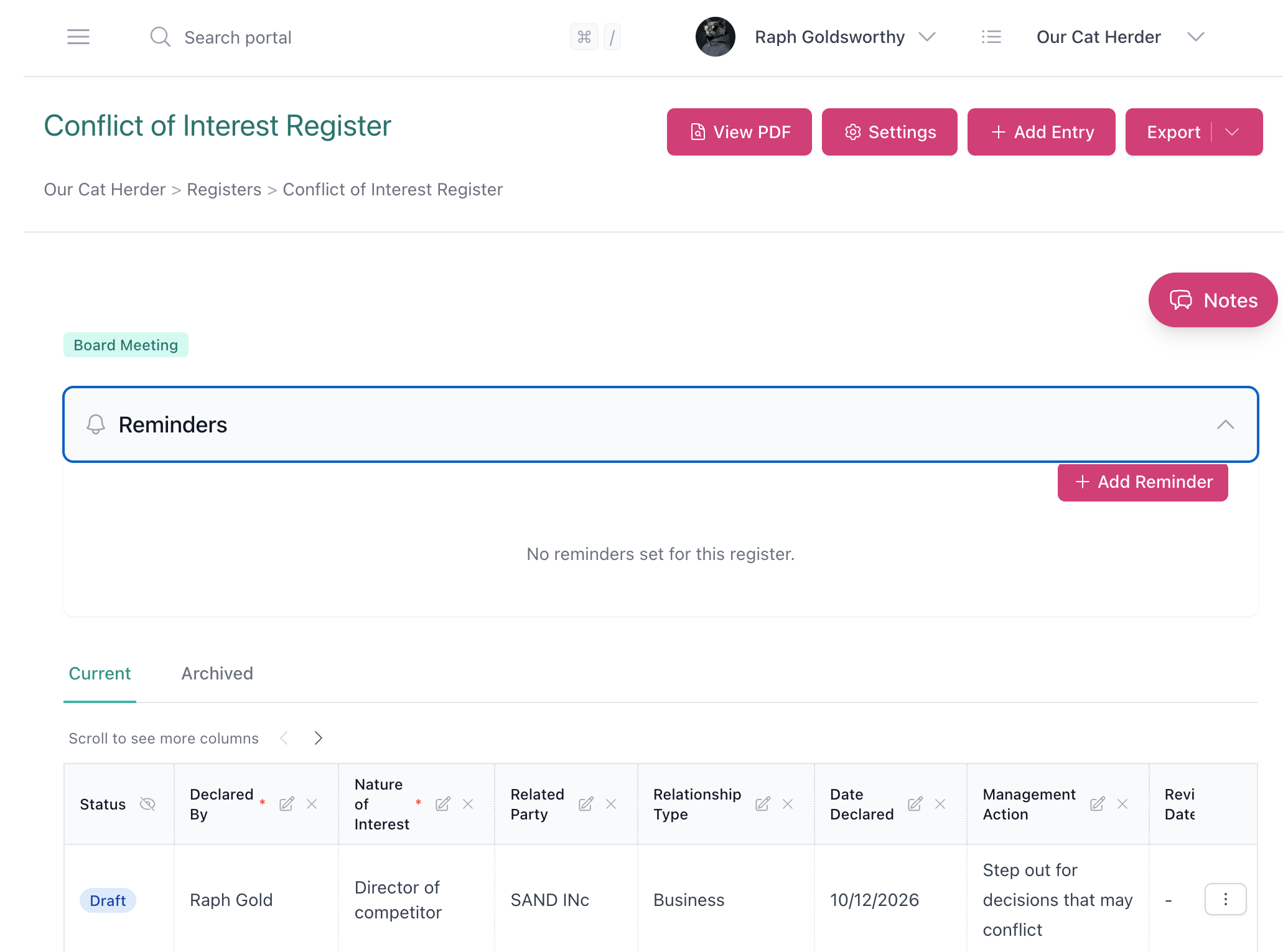
- Directors declare through a form
- Share a form with portal members. They submit or update a declaration before the meeting, signed in. Each submission lands on the register. They do not need access to the whole register to do it.
- Add the entry while taking the minutes
- When a director declares in the room, the minute-taker adds the row without leaving the minutes. The entry stays on the register and in the meeting record.
- A review date, with a reminder
- Set a reminder on the register so standing interests are confirmed, rather than waiting until someone remembers the spreadsheet.
- One current record in the meeting
- Open the register from the meeting as a PDF. The chair is looking at the same list the secretary updated, not a copy from the last board pack.
- Restrict the papers on one item
- When the management action is to restrict the papers, the chair makes that agenda item confidential and excludes the director. They see the rest of the pack, and the item's papers and minutes stay hidden from them. See how confidential agenda items work.
Ready to stop keeping the register in a file? Start your free 45-day trial.
Full access to all features. No credit card required. Set up in under 5 minutes.
Frequently asked questions about conflict of interest registers
- What is a conflict of interest register?
- A conflict of interest register records interests that could affect, or be seen to affect, decisions made for an organisation. Each entry names who declared, what the interest is, the related party, and what the board did about it. The minutes cover that meeting. The register is the list you bring to the next one.
- What should a conflict of interest register include?
- Include the date declared, the person and their role, whether the conflict is actual, potential, or perceived, a plain description of the interest, the related party, the relationship type, the management action the board agreed, a review date, and a status such as Open, Standing, or Closed.
- How often should a conflict of interest register be updated?
- Update the register when someone declares an interest or an interest changes, as well as at the annual declaration. Review it at the start of each board or committee meeting, before decisions, and confirm standing interests at least once a year. Keep closed entries so the board can show what it knew when it made an earlier decision.